
What is a Toggle Switch? Understanding the Basics
A toggle switch is a fundamental electrical component that controls circuit connectivity through a mechanical lever mechanism. Unlike push-button switches that require continuous pressure, toggle switches maintain their position until manually changed, providing stable ON or OFF states for electrical circuits in industrial equipment, automotive systems, and consumer electronics.
The term “toggle” derives from a French word meaning “a pin used to secure a rope,” describing the distinctive lever mechanism that users flip between positions. This simple yet effective design has made toggle switches one of the most reliable and widely-used switch types across industries for over a century.
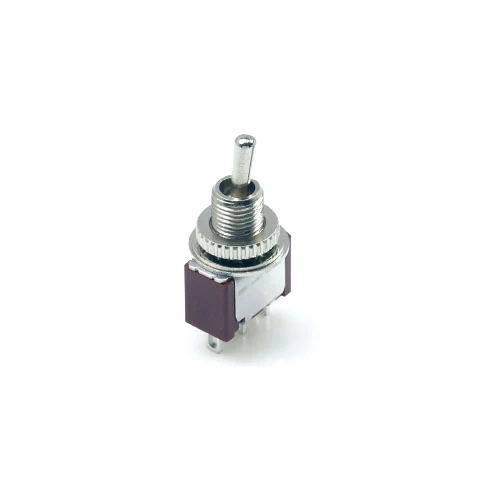
Toggle Switch Types: SPST, SPDT, DPST, DPDT Explained
Understanding toggle switch configurations is essential for selecting the right component for your application. The terminology describes two key parameters: poles (the number of independent circuits controlled) and throws (the number of output positions available).
SPST Toggle Switch
An SPST (Single Pole Single Throw) toggle switch controls one circuit with two positions: ON or OFF. This is the simplest configuration, ideal for basic power switching applications where you need to simply turn a circuit on or off without any complexity.
Best for: Power buttons, lighting controls, simple ON/OFF functions
SPDT Toggle Switch
An SPDT (Single Pole Double Throw) toggle switch controls one circuit but can connect to two different outputs. This allows switching between two power sources or routing a signal to different destinations without turning the circuit off.
Best for: Power source selection, signal routing, reversing motor direction
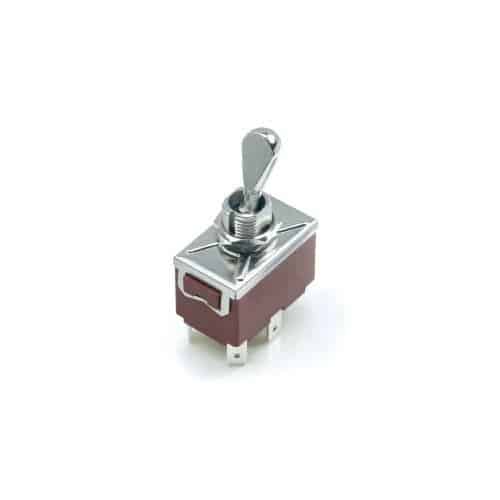
DPST Toggle Switch
A DPST (Double Pole Single Throw) toggle switch controls two independent circuits simultaneously with a single ON/OFF action. Both poles switch together, making it ideal for applications requiring simultaneous control of multiple circuits that share a common ground or power source.
Best for: Dual-power systems, equipment requiring isolated circuits, 240V applications
DPDT Toggle Switch
The DPDT (Double Pole Double Throw) toggle switch is the most versatile configuration, controlling two independent circuits with two selectable positions each. This enables complex switching scenarios like polarity reversal, multiple power routing, or controlling two devices with different configurations.
Best for: Polarity reversal, dual-power routing, complex control systems, marine applications
Key Specifications to Consider
Electrical Ratings
Understanding current and voltage ratings prevents switch failure and safety hazards:
- Current Rating: Typically 10A @ 125VAC for standard toggle switches. Higher ratings (16A, 20A) available for heavy-duty applications.
- Voltage Rating: Common ratings include 250V AC, 125V AC, and 30V DC for low-voltage applications.
- Horsepower Rating: Critical for motor control applications—verify the HP rating matches your motor requirements.
Mechanical Life and Cycles
Toggle switches are rated by mechanical cycles—the number of actuations before failure. Quality switches like WEUP offer 50,000 to 100,000 mechanical cycles, while standard commercial switches may only provide 10,000 to 30,000 cycles.
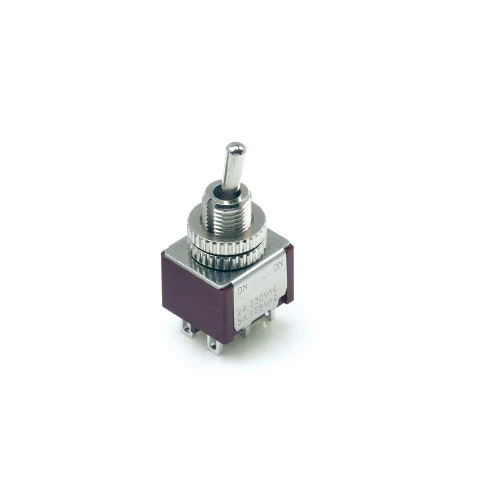
Actuator Styles and Mounting
Toggle switches come in various actuator styles:
- Standard Bat Handle: The classic toggle lever, suitable for most general applications
- Flat Blade: Screwdriver-activated for tamper-resistant installations
- Locking: Includes a locking mechanism to prevent accidental switching
- Fluted: Enhanced grip for easy manual operation
- Paddle: Broad surface area, ideal for medical or aerospace applications
Mounting Types: Panel Mount vs. PC Mount
Panel Mount Toggle Switches
Panel mount toggle switches install through equipment enclosures, providing user interface control from external locations. Standard bushing sizes include 6mm, 10mm, and 12mm diameters, with various thread pitches for secure mounting.
Panel mount switches typically use quick-connect terminals (4.8mm or 6.3mm) or screw terminals for wire connection, making them suitable for high-current applications and easy field installation.
PC Mount (Through-Hole) Toggle Switches
PC mount toggle switches solder directly to circuit boards, ideal for automated assembly and compact designs. These typically handle lower currents (often 1A to 5A) but offer consistent, reliable connections for electronic circuits.
How to Wire a Toggle Switch
Wiring SPST Toggle Switch
An SPST switch requires only two connections: one wire to the input (Line) and one to the output (Load). The switch interrupts power flow between these points when in the OFF position.
- Terminal 1 (COM): Connect to power source (Line/L)
- Terminal 2 (NO): Connect to load (Load/L)
Wiring DPDT Toggle Switch
A DPDT switch has six terminals: two common (C) inputs and four switched outputs (NO1, NC1, NO2, NC2). Wire the power source to the common terminals, and connect your loads to the normally open and normally closed terminals according to your circuit requirements.
- Terminal 1 (COM1): Input for Circuit 1
- Terminal 2 (NO1): Output 1 – Position A
- Terminal 3 (NC1): Output 1 – Position B
- Terminal 4 (COM2): Input for Circuit 2
- Terminal 5 (NO2): Output 2 – Position A
- Terminal 6 (NC2): Output 2 – Position B
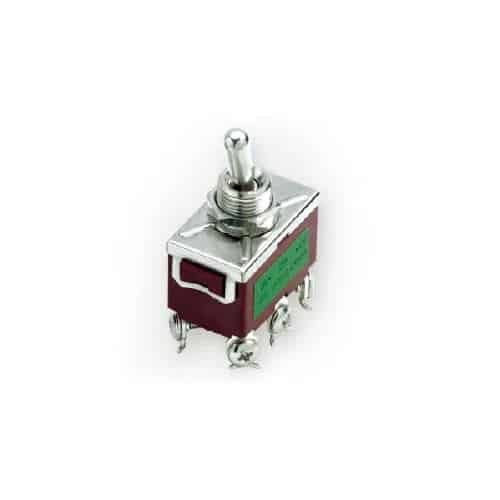
Quality Certifications and Standards
When selecting toggle switches for industrial or commercial applications, verify compliance with relevant safety and quality standards:
- ISO 9001:2015 – Quality Management Systems ensuring consistent manufacturing standards
- UL Listing – Underwriters Laboratories certification for electrical safety in North American markets
- CE Marking – European Union compliance for products sold in EU member states
- NEMA Standards – National Electrical Manufacturers Association specifications for industrial switchgear
Applications by Industry
Toggle switches serve diverse applications across multiple industries:
- Industrial Equipment: CNC machines, PLC control panels, manufacturing automation, conveyor systems
- Medical Devices: Diagnostic equipment, patient monitoring systems, medical imaging devices
- Telecommunications: Network switching equipment, signal routing, communication infrastructure
- Marine Electronics: Bilge pumps, navigation systems, lighting controls, anchor windlasses
- Automotive: Accessory switches, dashboard controls, horn and lighting circuits
- Test and Measurement: Oscilloscopes, power supplies, testing fixtures, calibration equipment
Why Choose WEUP Toggle Switches?
WEUP has over 20 years of experience manufacturing precision electrical switches for global markets. Our toggle switches combine proven reliability with competitive pricing, serving customers in more than 40 countries.
Quality Assurance: All WEUP toggle switches undergo rigorous testing including 100% functional inspection, dielectric strength verification, and lifetime testing to ensure reliable performance in demanding environments.
Customization: We offer tailored solutions including custom actuator lengths, specialized terminal configurations, and branding options for volume orders. Our engineering team supports prototype development through production scaling.
Explore our complete range of toggle switches including SPST, SPDT, DPDT, and heavy-duty configurations for every application requirement.