
Wiring a toggle switch correctly is essential for reliable circuit operation in industrial control panels, automotive systems, and power distribution equipment. This guide covers the four most common toggle switch configurations — SPST, SPDT, DPST, and DPDT — with terminal identification, wiring steps, and application examples for each type.
If you are unsure about the differences between these configurations, read our Toggle Switch Types Explained guide first.
SPST Toggle Switch Wiring
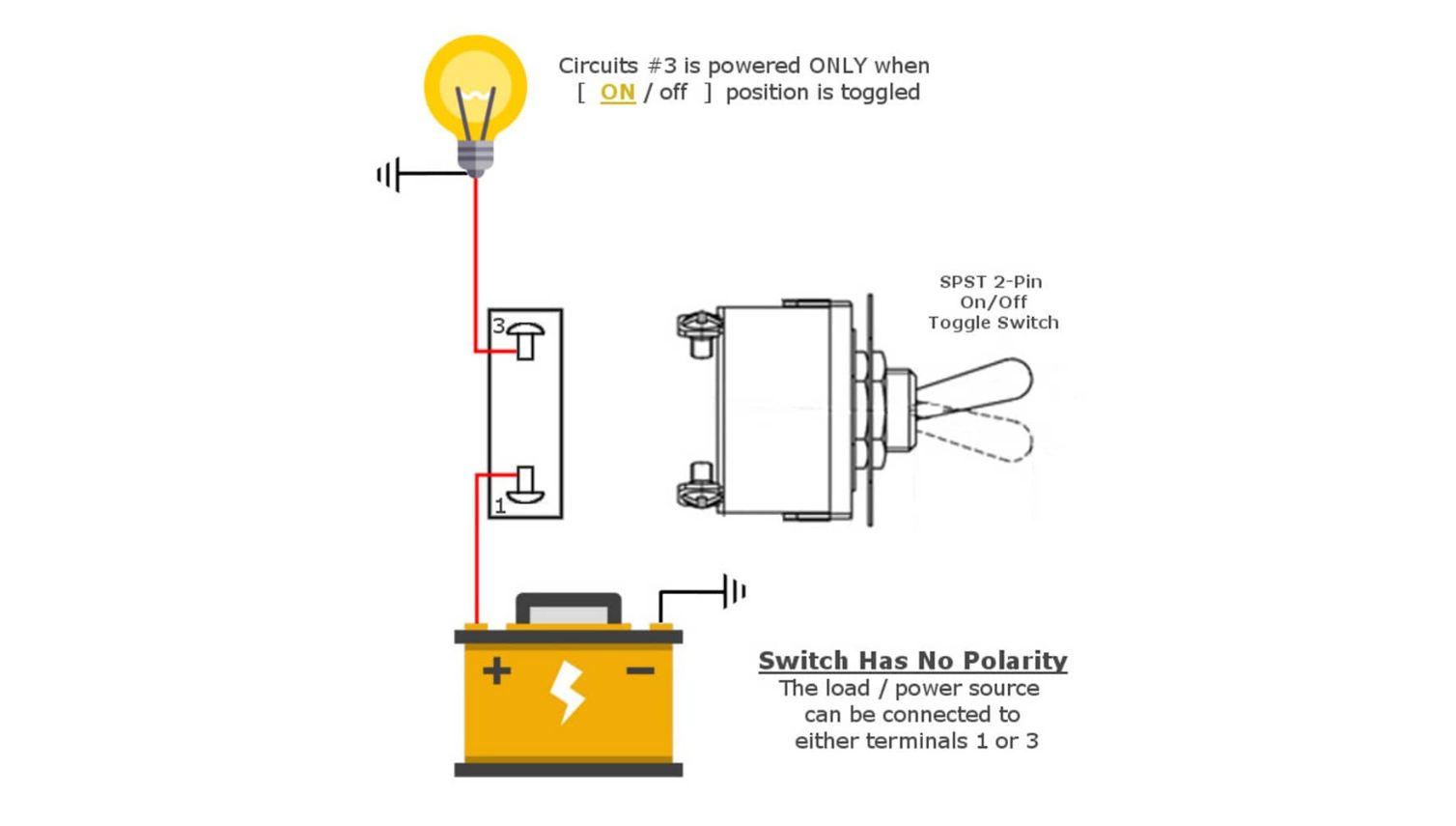
An SPST (Single Pole Single Throw) toggle switch is the simplest configuration. It controls one circuit with two positions: ON and OFF.
Terminal Identification
- Terminal 1: Power input (Line)
- Terminal 2: Load output
Wiring Steps
- Connect the positive power wire to Terminal 1.
- Connect the load wire to Terminal 2.
- Connect the ground/neutral wires directly (the switch only interrupts the live wire).
Common Applications
- Basic ON/OFF power control
- Simple lighting circuits
- Low-cost consumer equipment
SPST switches are available in our Toggle Switches product line. Browse QNM series SPST models rated 10A/250V AC.
SPDT Toggle Switch Wiring
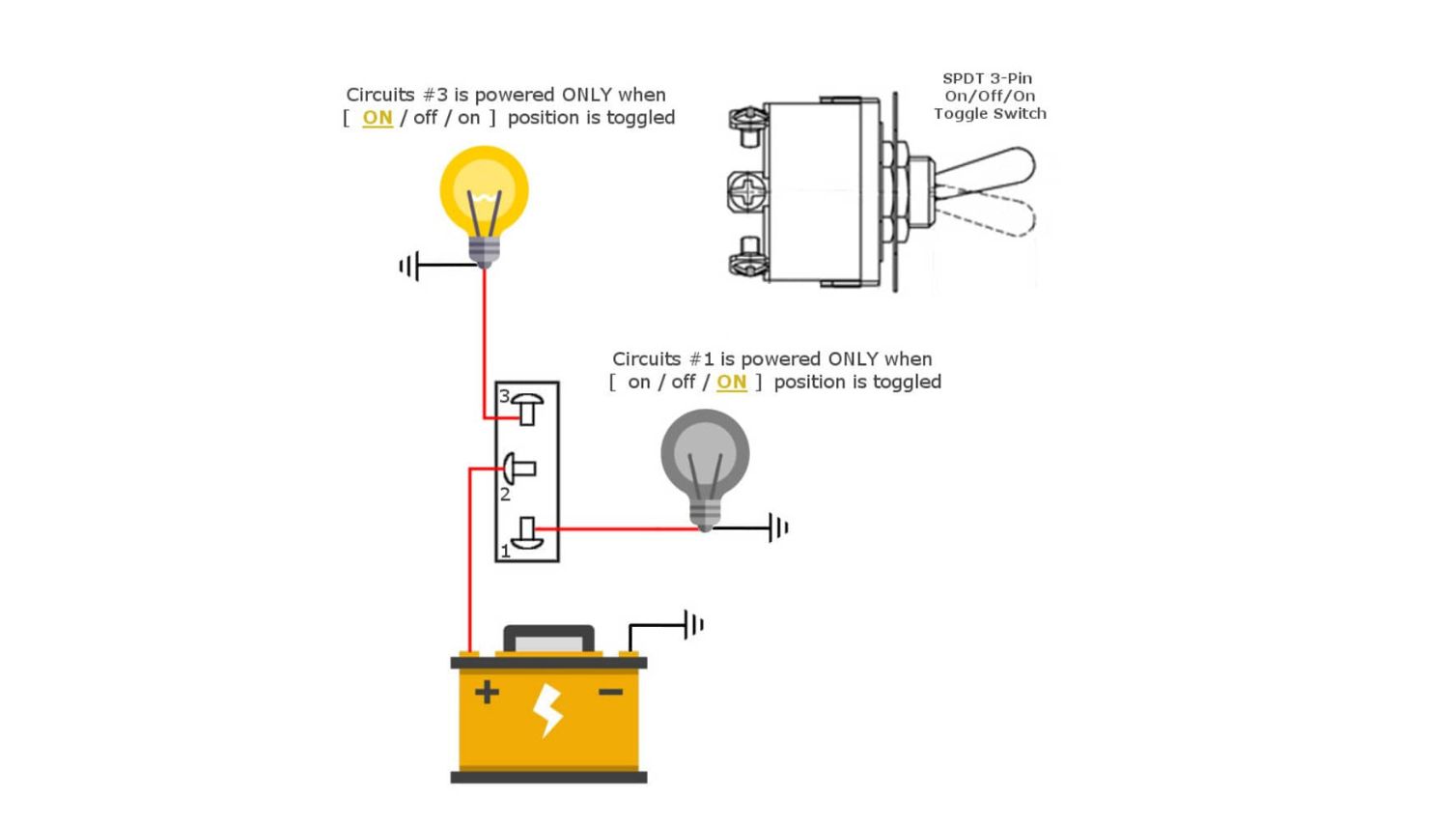
An SPDT (Single Pole Double Throw) switch controls one circuit but can connect to two different outputs. It has three terminals.
Terminal Identification
- Common (C): Power input
- Normally Open (NO): Connected when switch is toggled ON
- Normally Closed (NC): Connected when switch is in default position
Wiring Steps (Switching Between Two Loads)
- Connect the power source to the Common terminal.
- Connect Load A to the Normally Open terminal.
- Connect Load B to the Normally Closed terminal.
Application Example
Switching between a main pump and a backup pump in an industrial control system. When the switch is toggled, control shifts from one pump to the other without interrupting the circuit.
WEUP offers SPDT toggle switches in multiple actuator styles and current ratings. View SPDT models.
DPST Toggle Switch Wiring
A DPST (Double Pole Single Throw) switch controls two independent circuits simultaneously with a single ON/OFF action.
Terminal Identification
- Pole 1 Input (L1)
- Pole 1 Output (Load 1)
- Pole 2 Input (L2)
- Pole 2 Output (Load 2)
Wiring Steps
- Connect the first power line to Pole 1 Input.
- Connect the second power line to Pole 2 Input.
- Connect Load 1 to Pole 1 Output.
- Connect Load 2 to Pole 2 Output.
Common Applications
- Simultaneously switching both live and neutral wires in AC circuits
- Controlling two independent circuits that must always operate together
- Power supply units requiring both poles switched
Tip: DPST switches are often preferred for safety-critical applications because they completely isolate the equipment from the power source by switching both conductors.
DPDT Toggle Switch Wiring
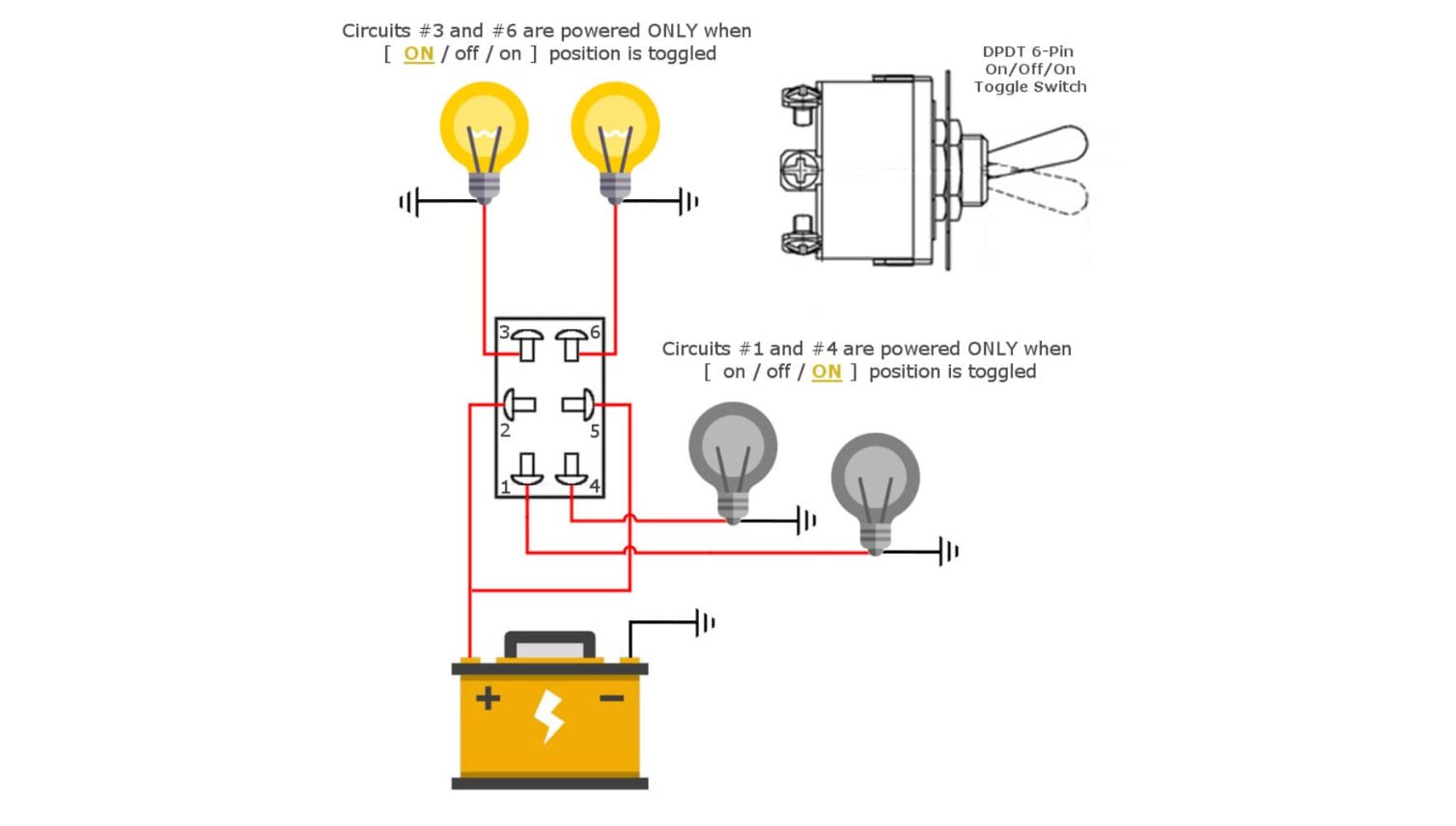
A DPDT (Double Pole Double Throw) switch is the most versatile configuration. It controls two independent circuits with two selectable positions each — six terminals total.
Terminal Identification
- Common 1 (C1), Common 2 (C2)
- Normally Open 1 (NO1), Normally Open 2 (NO2)
- Normally Closed 1 (NC1), Normally Closed 2 (NC2)
Wiring Steps (Motor Polarity Reversal)
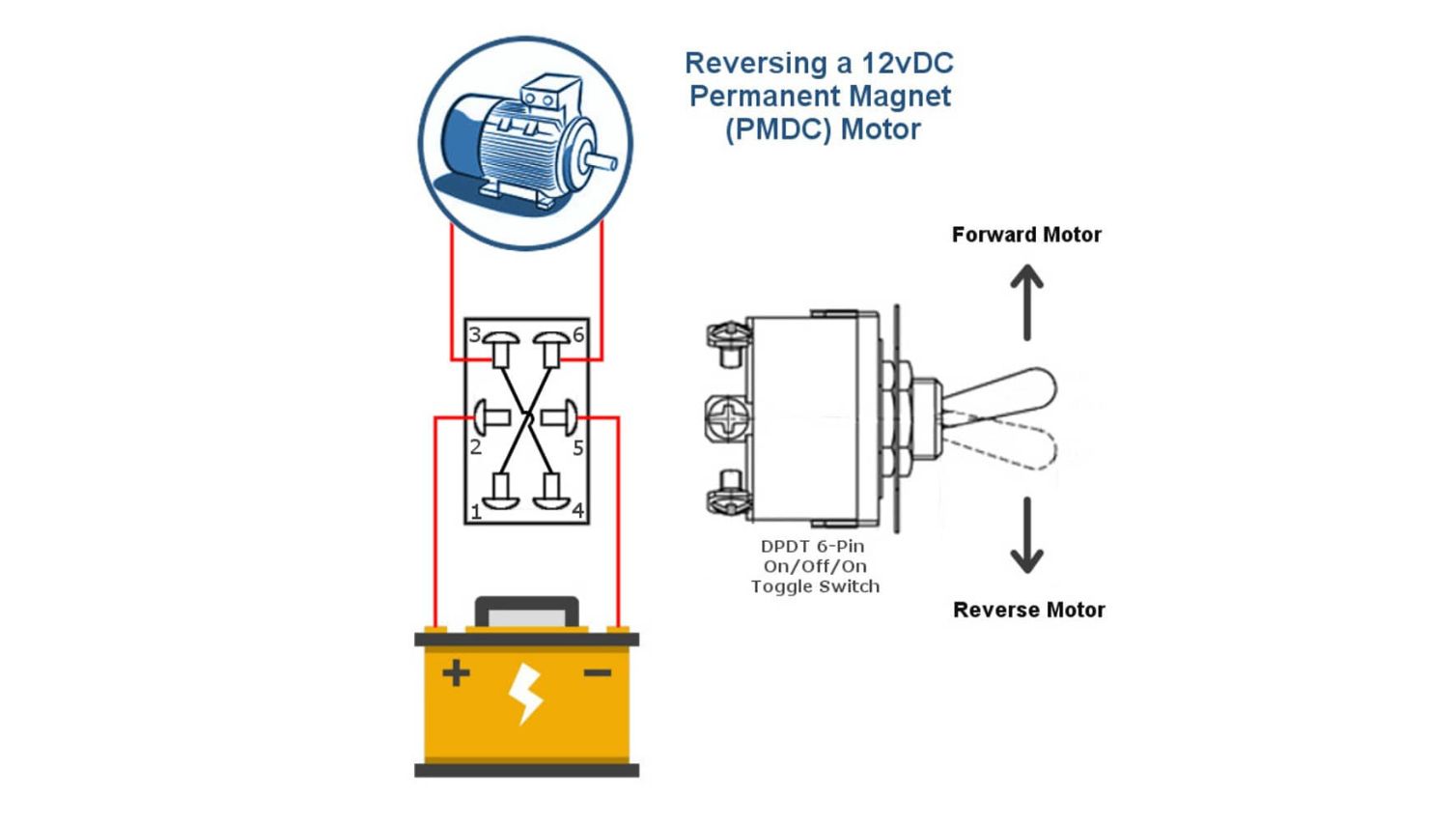
- Connect the positive power wire to C1. Connect the negative power wire to C2.
- Connect motor wire A to NO1 and NC2.
- Connect motor wire B to NO2 and NC1.
- In Position 1, current flows through NO1 and NO2 (motor runs forward).
- In Position 2, current flows through NC1 and NC2 (motor runs reverse).
Application Example
Polarity reversal for DC motor direction control, lift tables, conveyor belt reversals, and actuator extend/retract functions.
WEUP DPDT toggle switches support up to 10A/250V AC and 50,000+ mechanical cycles. Browse DPDT models.
Wiring Safety Guidelines
- Always disconnect power before wiring or testing switches.
- Verify that the switch voltage and current ratings exceed your maximum load.
- Use appropriately rated wire gauge for your application (typically 18 AWG to 14 AWG for most industrial toggle switches).
- For DC circuits, confirm the switch is rated for DC voltage — DC arcing is more severe than AC.
- Secure terminal connections with the recommended torque to prevent loose connections and heat buildup.
Common Wiring Mistakes to Avoid
- Reversing NO and NC terminals — Always verify terminal function with a multimeter before connecting loads.
- Using the wrong switch rating — A switch rated for 5A will fail prematurely if used with a 10A load.
- Forgetting to switch both poles on DPST/DPDT — Double-check that both poles are wired correctly and actuate together.
Frequently Asked Questions
What is the difference between SPST and SPDT wiring?
SPST switches have two terminals and control one circuit with ON/OFF action. SPDT switches have three terminals and can switch between two different outputs from a single input.
How many terminals does a DPDT switch have?
A DPDT switch has six terminals: two Common, two Normally Open, and two Normally Closed. This allows controlling two independent circuits with two output positions each.
Can I use a toggle switch for both AC and DC circuits?
Only if the switch is rated for both. DC circuits require higher current ratings due to continuous arcing. Always check the manufacturer’s specifications. WEUP toggle switches specify both AC and DC ratings where applicable.
What wire gauge should I use for toggle switch wiring?
For most industrial toggle switches rated 10A – 15A, 18 AWG to 14 AWG wire is appropriate. For higher currents, consult the switch manufacturer’s recommendations and local electrical codes.
How do I identify the Common terminal on an SPDT toggle switch?
The Common terminal is typically the center terminal on a three-terminal SPDT switch. Use a multimeter in continuity mode to verify: the Common terminal shows continuity with the NC terminal when the switch is in its default position.
About WEUP Technology
WEUP Technology has manufactured precision toggle switches for over 20 years, serving B2B clients in 40+ countries. Our QNM series toggle switches are available in SPST, SPDT, DPST, and DPDT configurations with panel mount and PC mount options. All switches are UL, CE, and RoHS certified with mechanical life ratings of 50,000 to 100,000 cycles. Custom terminal styles, actuator colors, and markings are available for OEM orders.