
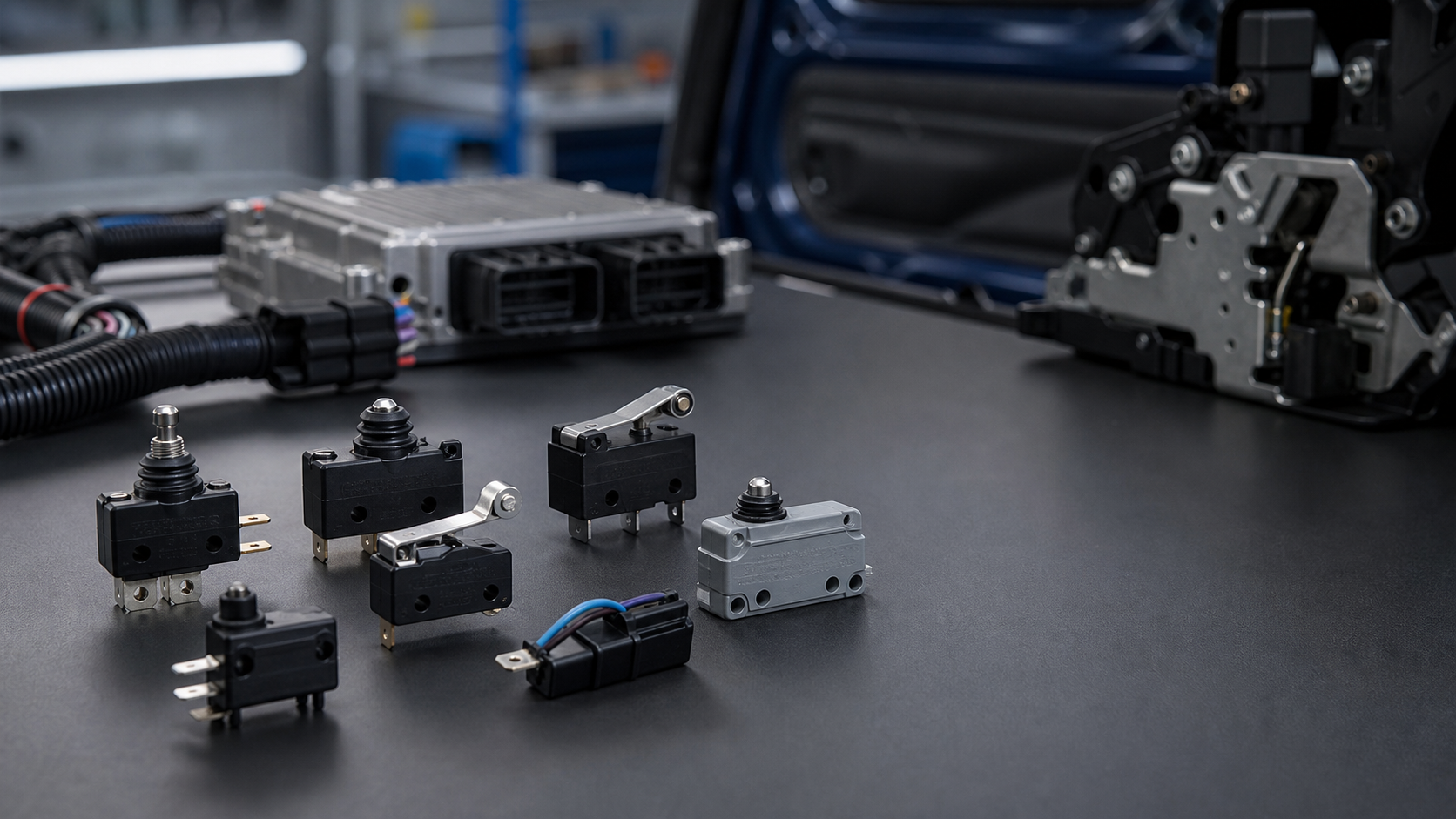
Modern vehicles rely on compact, reliable sensing components to confirm position, movement, and safety status across multiple systems. Among these components, automotive micro switches play an important role in door detection, brake pedal sensing, seat position feedback, trunk monitoring, hood detection, and electric vehicle charging port control.
For OEMs, Tier 1 suppliers, and automotive electronics manufacturers, choosing the right micro switch is not only about size or current rating. It is about long-term reliability, stable signal output, vibration resistance, environmental protection, and consistent quality in mass production.
WEUP provides precision micro switch solutions for automotive, industrial, waterproof, and custom applications. You can explore our full Micro Switches catalog or contact our engineering team for customized automotive switch requirements.
What Is an Automotive Micro Switch?
An automotive micro switch is a compact snap-action switch used to detect mechanical position or movement inside a vehicle. When the actuator is pressed, released, or moved by a mechanical part, the switch changes its electrical state and sends a signal to the vehicle control system.
In most automotive applications, micro switches are used for three core functions:
- Status detection
- Position feedback
- Safety interlock
If you are new to the basic working principle, you can also read WEUP’s guide: What Are Micro Switches?
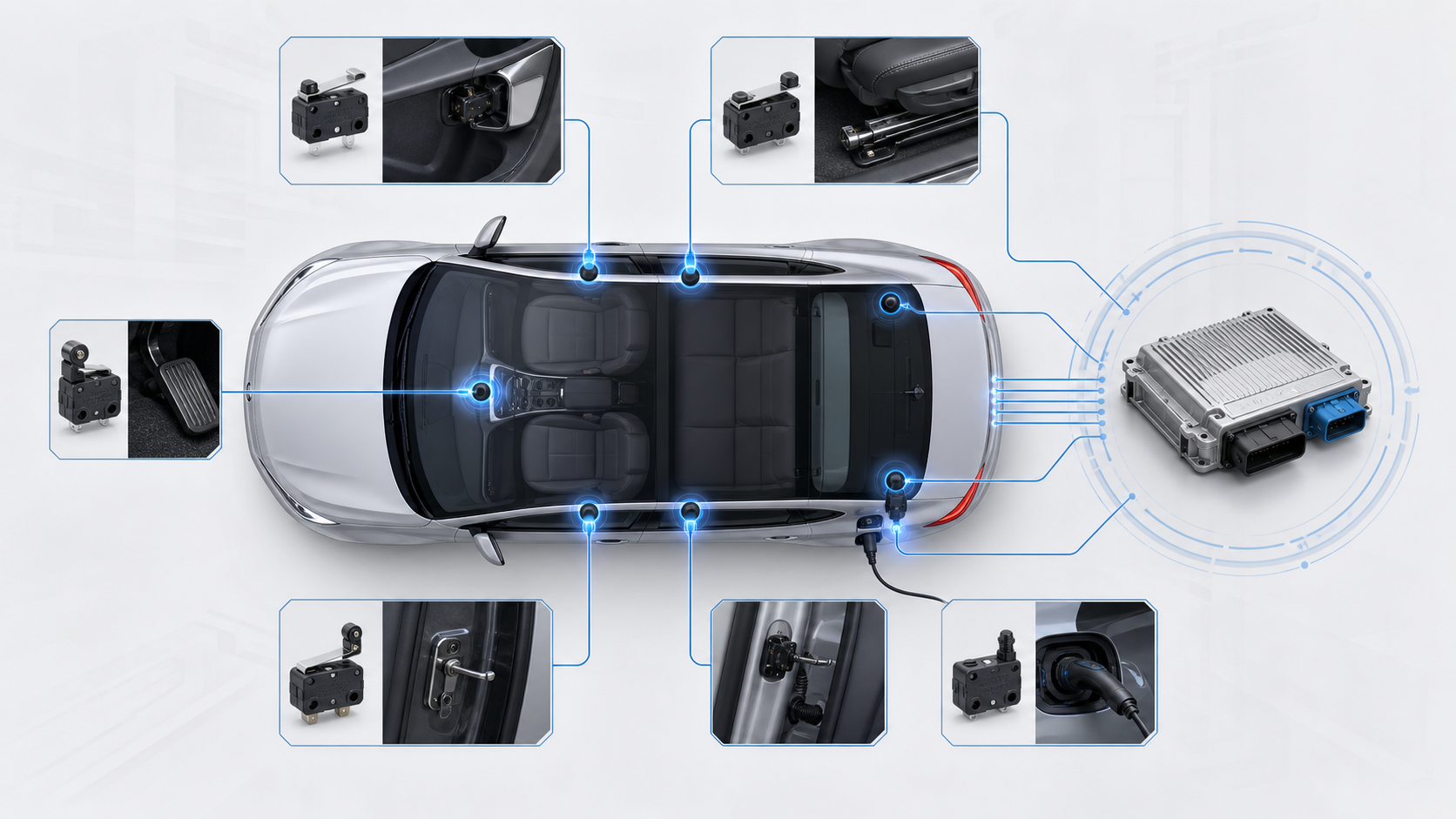
Key Automotive Applications
Door and Body Control Systems
Micro switches are widely used in door ajar detection, trunk latch detection, hood detection, interior light control, and central locking feedback.
When a vehicle door, trunk, or hood opens or closes, the micro switch provides a clear signal to the body control module. This helps control warning lights, alarm systems, interior lighting, and vehicle safety logic.
Typical applications include:
- Door ajar switch
- Trunk switch
- Hood switch
- Central lock feedback switch
- Interior light trigger switch
For buyers comparing product types, WEUP’s Micro Switches page includes multiple actuator options such as pin plunger, hinge lever, roller lever, and long hinge lever designs.
Seat Position and Limit Detection
Automotive seats require compact and repeatable position detection. Micro switches can be used to detect seat travel limits, lock position, and adjustment endpoints.
Common uses include:
- Seat forward and backward limit detection
- Seat height adjustment limit detection
- Seat lock confirmation
- Seat mechanism position feedback
For these applications, stable operating force, consistent travel distance, and long mechanical life are important selection factors.
Brake Pedal and Safety Systems
Brake pedal switches and safety interlock switches require higher reliability because they are linked to vehicle safety signals.
Automotive micro switches may be used for:
- Brake pedal position detection
- Brake light signal triggering
- Clutch pedal detection
- Seat belt buckle detection
- Safety interlock circuits
In these applications, low contact resistance, vibration resistance, and stable switching over long service life are critical.
Electric Vehicle Applications
Electric vehicles create new demand for compact sensing components. Micro switches can be used in charging port covers, battery compartment doors, automatic doors, and actuator feedback systems.
Typical EV applications include:
- Charging port cover detection
- Battery compartment access detection
- Electric tailgate feedback
- Automatic door actuator position sensing
- Small mechanism limit detection
Because EV platforms often involve low-current signal circuits, micro switches must provide reliable contact performance under small electrical loads.
Automotive Requirements for Micro Switches
Automotive environments are more demanding than ordinary consumer or light industrial applications. A reliable automotive micro switch should be selected according to the actual installation environment and control requirement.
High Reliability
Automotive switches may need to operate for hundreds of thousands or millions of cycles. Door, seat, brake, and actuator systems all require stable mechanical life and repeatable actuation.
Wide Temperature Range
Automotive applications may require operation from -40°C to +85°C, +105°C, or +125°C depending on the location. Under-hood and exposed vehicle areas usually require higher temperature resistance.
Waterproof and Dustproof Protection
For door, trunk, exterior, and exposed vehicle positions, sealed designs are often required. IP67 or IP68 protection helps prevent water, dust, mud, and moisture from affecting switch performance.
For more information about waterproof selection, see WEUP’s Waterproof Micro Switches page and Waterproof Switch IP Ratings Explained.
Vibration and Shock Resistance
Vehicles operate in constant vibration and shock conditions. A suitable automotive micro switch should maintain stable contact performance and avoid false triggering caused by vibration.
Stable Electrical Signal
Many automotive micro switches are connected to ECU or BCM input circuits. Low contact resistance and stable switching behavior are important for accurate signal detection.
If your project requires wiring guidance, see Ultimate Guide to Micro Switch Wiring.
Automotive Micro Switch Solution Structure
A reliable automotive micro switch solution should be evaluated from mechanical design, material selection, and electrical performance.
Mechanical Design
Key mechanical design factors include:
- Sealed housing structure
- Stable snap-action mechanism
- Optimized actuator or lever design
- Anti-jamming structure
- Consistent operating force
- Reliable reset performance
Different vehicle systems may require different actuator styles. For example, a door latch system may use a lever actuator, while a pedal detection system may use a plunger or short lever structure.
Material Selection
Material selection affects durability, heat resistance, sealing performance, and electrical stability.
| Component | Recommended Material |
|---|---|
| Housing | PBT / PA66 + GF |
| Contact | Silver alloy, AgNi, AgSnO2 |
| Spring | Stainless steel / phosphor bronze |
| Seal | Silicone rubber / EPDM |
| Terminal | Tin-plated or nickel-plated copper |
Electrical Performance
Automotive micro switches are commonly used in 5V, 12V, and 24V control systems. Depending on the application, buyers should check contact form, current rating, terminal type, and expected electrical life.
WEUP micro switches include SPDT, SPST-NO, and SPST-NC options. You can compare models directly on the Micro Switches catalog page.
Recommended Product Types
Standard Micro Switches
Suitable for interior vehicle systems, light-duty detection, and cost-sensitive applications.
Typical uses:
- Interior light control
- General status detection
- Seat mechanism feedback
- Low-exposure body control systems
Sealed Micro Switches
Suitable for environments exposed to moisture, dust, or vibration.
Typical uses:
- Door latch detection
- Trunk detection
- Hood detection
- Charging port cover detection
- Outdoor or semi-exposed vehicle mechanisms
See also: Waterproof Micro Switches
High-Reliability Safety Micro Switches
Suitable for safety-related circuits that require higher durability and signal stability.
Typical uses:
- Brake pedal detection
- Seat belt buckle detection
- Safety interlock systems
- Transmission or actuator feedback
Custom Automotive Micro Switch Solutions
Automotive projects often require custom actuator shapes, mounting structures, terminal styles, wire harnesses, or sealing designs.
WEUP supports custom switch solutions for different applications. You can learn more from the Application Center or request a custom solution through the Contact page.
How to Select the Right Automotive Micro Switch
When selecting a micro switch for automotive applications, buyers should confirm the following factors:
- Installation location
- Required operating force
- Actuator type
- Contact form: SPDT, SPST-NO, or SPST-NC
- Voltage and current rating
- Mechanical life requirement
- Temperature range
- IP rating
- Vibration requirement
- Terminal type
- Wiring or connector requirement
- Certification and quality documentation needs
For broader industrial comparison, you can also read WEUP’s Micro Switch Industrial Applications Guide.
WEUP Automotive Micro Switch Advantages
WEUP provides reliable switch manufacturing backed by more than 20 years of experience. Our automotive micro switch solutions are designed to support stable performance, flexible customization, and global market requirements.
Key advantages include:
- 20+ years of switch manufacturing experience
- ISO 9001 certified production
- UL and CE certified product quality
- Multiple actuator and terminal options
- Custom structure and wiring support
- Stable quality for long-term supply
- Fast response for engineering and sourcing teams
Explore available models here: WEUP Micro Switches
Conclusion
Automotive micro switches are small components, but they are essential for vehicle safety, body control, seat adjustment, braking systems, and electric vehicle mechanisms. A well-selected micro switch can improve signal accuracy, reduce failure risk, and support long-term vehicle reliability.
For automotive applications, buyers should focus on mechanical life, sealing performance, temperature resistance, vibration stability, contact reliability, and customization options.
If you need micro switches for door systems, brake pedals, seat position detection, trunk monitoring, hood detection, or EV charging port covers, WEUP can help you select or customize a suitable solution.
Request a Quote or explore the full Micro Switches Catalog.