
x
Send Your Inquiry Today

Switches of High-Pressure Homogenizers: Key Components Ensuring Safe and Efficient Equipment Operation

Global Leader in Switch Manufacturing

In fields such as food processing, biomedicine, and chemical engineering, high-pressure homogenizers have become indispensable core equipment in production processes due to their powerful material refinement and mixing capabilities. Within the operation and safety system of this precision equipment, switches of high-pressure homogenizers play a crucial role as “gatekeepers”. They are not only the direct control units for starting, stopping, and switching the operating status of the equipment but also the key barriers to ensuring the safety of operators and preventing overload damage to the equipment. A thorough understanding of the types, functions, operating specifications, and maintenance points of high-pressure homogenizer switches is of great significance for improving production efficiency and avoiding safety risks.

1. Basic Understanding of High-Pressure Homogenizer Switches: Types and Core Functions

The switches of a high-pressure homogenizer are not a single component but a collection of multi-type control units designed according to the equipment’s operating requirements. Different types of switches undertake different functions and together form the “nerve center” of the equipment.
From the perspective of functional classification, the most core one is the main power switch, which serves as the main hub connecting the high-pressure homogenizer to the external power supply system. It is usually designed as a circuit breaker with leakage protection. This type of switch not only controls the on-off of the equipment’s main power supply but also has overload protection and leakage protection functions. When the equipment experiences an abnormal current increase due to a short circuit or motor overload, the circuit breaker will automatically trip to cut off the power supply.
If the equipment shell is accidentally electrified, the leakage protection module can trigger a power outage within 0.1 seconds, maximizing the protection of the operator’s personal safety. In the food and biomedical industries, the main power switch must also meet the protection level of IP65 or above to prevent moisture and dust in the production environment from entering and affecting the switch performance.
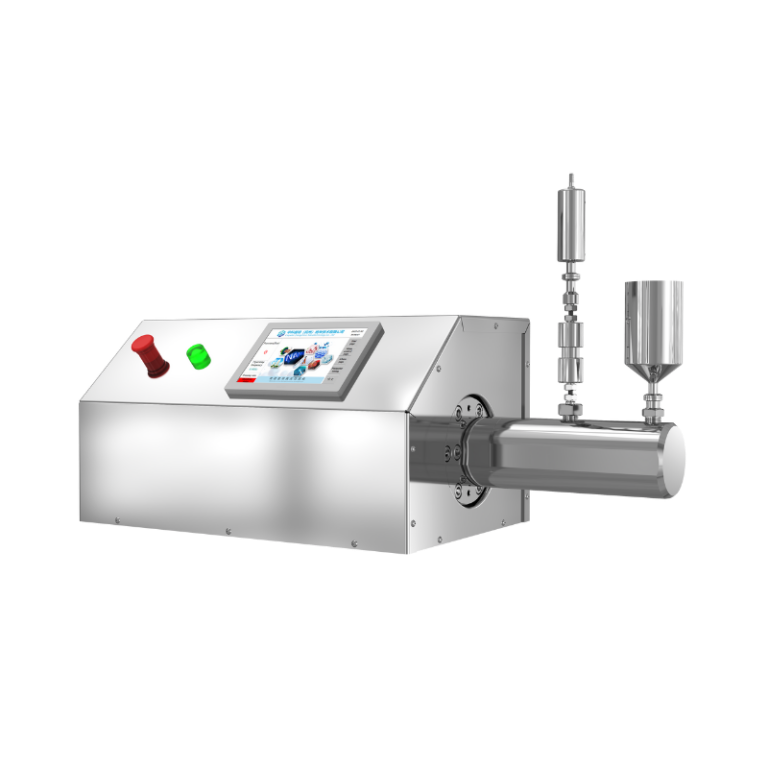
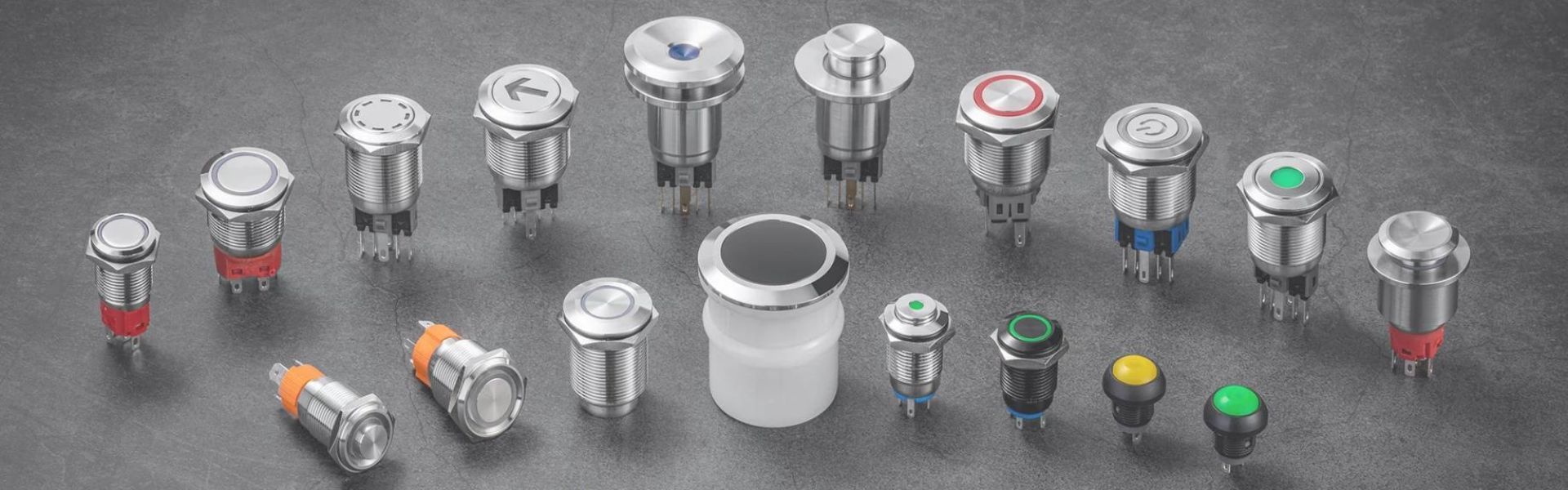
Secondly, there are operation control switches, which are directly related to the working status of the high-pressure homogenizer. Common forms include knob-type, button-type, and touch-type switches. Knob-type switches are mostly used to adjust the equipment’s operating mode, such as switching among three gears: “Standby – Operation – Cleaning”, allowing operators to make precise selections according to the production process requirements. Button-type switches focus on “Start”, “Stop”, and “Emergency Stop” functions. Among them, the emergency stop switch is the top priority of safety control. It is usually designed with a striking red mushroom head and installed in a prominent position on the equipment’s operation panel.
When emergency situations such as material leakage, abnormal pressure, or abnormal noise occur, the operator can press it with one button to cut off the equipment’s power source, force the equipment to stop running, and avoid the expansion of accidents. With the development of intelligence, touch-type switches have gradually been applied to high-end models. They realize the integration of switch operation and parameter display through a capacitive screen, improving the convenience of operation.
In addition, some high-pressure homogenizers are also equipped with auxiliary function switches, such as cooling system switches and feed pump switches. These switches are linked with the main operation system. For example, when the equipment starts to operate, the cooling system switch will be automatically activated to cool the high-pressure pump and homogenizing valve. If the feed pump switch is not turned on, the main operation switch will be in a locked state to prevent the equipment from running idle and causing damage, which reflects the interlock protection logic in the switch design.

2. Operating Specifications for High-Pressure Homogenizer Switches: Full-Process Control from Start-Up to Shutdown

Correct operation of high-pressure homogenizer switches is the prerequisite for the stable operation of the equipment and the safety of personnel. It is necessary to follow the full-process specifications of “Inspection – Start-Up – Operation – Shutdown” to avoid equipment failures or safety accidents caused by improper operation.
In the pre-startup inspection phase, first, confirm that the main power switch is in the “Off” state, and check whether the appearance of the switch is intact, with no signs of damage, looseness, or leakage. Secondly, check whether the emergency stop switch is reset (the red mushroom head popping out indicates the reset state). If the emergency stop switch is in the pressed state, it must be rotated to reset before proceeding with subsequent operations. Finally, check the position of the auxiliary function switches (such as the cooling system and feed pump) to ensure they are in the “Off” state, preparing for the start-up process.
In the start-up operation phase, the switches must be operated in the order of “Auxiliary first, then main operation”: Step 1, close the main power switch, observe whether the equipment’s power indicator light is on, and confirm that the power supply is normal. Step 2, turn on the cooling system switch, check whether the cooling fan or cooling water circulation is started normally, and ensure that the equipment’s heat dissipation channel is unobstructed. Step 3, turn on the feed pump switch.
After the material stably enters the homogenizing cavity, rotate the operation mode switch to the “Operation” gear. At the same time, observe the value of the pressure gauge and slowly adjust the pressure to the set range. It should be noted that it is strictly prohibited to directly start the main operation switch without turning on the cooling system or feed pump, otherwise, it may cause overheating damage to the high-pressure pump or empty grinding wear of the homogenizing cavity.
During the operation process, it is necessary to pay close attention to the switch status and the equipment’s operating conditions. If the equipment exhibits abnormal vibration, abnormal noise, or a sudden pressure increase, the emergency stop switch should be pressed immediately to cut off the equipment’s power source. After troubleshooting the fault, reset the switch and restart the equipment. If a temporary shutdown is required, first adjust the operation mode switch to the “Standby” gear, then turn off the feed pump switch, and finally turn off the cooling system switch. Avoid directly disconnecting the main power switch, which may lead to material residue or pressure impact.
In the shutdown operation phase, the order of “Stop the load first, then cut off the power supply” must be followed: Step 1, adjust the operation mode switch to the “Stop” gear. After the equipment completely stops running, turn off the feed pump switch. Step 2, keep the cooling system switch on for 5-10 minutes. After the equipment temperature drops to room temperature, turn off the cooling system. Step 3, after confirming that the equipment is normal, disconnect the main power switch and check whether all switches have returned to the “Off” state to prepare for the next start-up. At the same time, it is necessary to clean the dust and dirt on the surface of the switches to avoid the accumulation of impurities affecting the sensitivity of the switch contacts.

3. Troubleshooting and Maintenance of High-Pressure Homogenizer Switches: The Key to Extending Service Life

During long-term use, the switches of high-pressure homogenizers may malfunction due to environmental factors, operating frequency, or component aging. Timely troubleshooting and daily maintenance are the keys to extending the service life of the switches and ensuring the reliability of the equipment.
Common switch faults include poor contact, tripping, and failure to reset. If there is poor contact in the switch (such as flickering equipment indicator lights or intermittent operation), it is mostly caused by oxidation of the internal contacts of the switch or loose wiring. In this case, first disconnect the main power supply, remove the switch panel, gently polish the oxide layer on the contact surface with fine sandpaper, and then re-tighten the wiring terminals to ensure good contact. If the main power switch trips frequently, first check whether there is a short circuit or overload in the equipment circuit (such as motor jamming or cable damage). After eliminating the circuit problem, check whether the overload protection parameters of the switch itself match the rated current of the equipment. If necessary, replace the circuit breaker with the same model. If the emergency stop switch fails to reset, it may be due to a damaged internal spring of the switch or foreign object jamming. The switch should be disassembled to clean the foreign objects. If the spring fails, the switch should be replaced in a timely manner to ensure the normal operation of the emergency stop function.
In terms of daily maintenance, a system of “regular inspection + cleaning and maintenance” should be established. A weekly visual inspection of all switches is required, focusing on the reset flexibility of the emergency stop switch, the smoothness of gear switching of the knob-type switch, and the response sensitivity of the touch-type switch. Every month, the main power supply should be disconnected to tighten the switch wiring terminals to prevent loose wiring caused by vibration. In production environments with high humidity or a lot of dust, protective treatment should be carried out on the switches every quarter, such as adding waterproof gaskets to knob-type switches and attaching anti-scratch and dust-proof films to touch-type switches, to avoid environmental factors affecting the switch performance. In addition, avoid operating the switches with wet hands to prevent leakage risks. It is strictly prohibited to tap or forcefully toggle the switches with tools to prevent damage to the mechanical structure of the switches.

4. Technological Development and Safety Management of High-Pressure Homogenizer Switches: Moving Towards Intelligence and Standardization

With the development of high-pressure homogenizers towards intelligence and automation, the switch components are also constantly upgraded, transforming from traditional mechanical switches to the “smart switch + Internet of Things” mode. For example, some high-end models adopt smart switches with data collection functions, which can record the operation time and state changes of the switches in real time and upload them to the cloud management platform through the Internet of Things. When an abnormality occurs in the switch (such as frequent tripping or contact aging), the platform will automatically issue an early warning to remind the management personnel to carry out maintenance in a timely manner. At the same time, smart switches also support remote control functions, allowing operators to realize remote start-up and shutdown of the switches through a mobile APP, facilitating the centralized management of multiple devices.
In terms of safety management, the design and use of high-pressure homogenizer switches must strictly comply with industry standards and regulations. For example, in the food processing industry, the switch materials must meet food-grade safety requirements to avoid heavy metal precipitation polluting the materials. In the biomedical industry, the switches must have explosion-proof functions to prevent flammable and explosive materials from burning and exploding due to electric sparks. In addition, enterprises need to strengthen the training of operators to ensure that they master the correct operation methods and emergency handling procedures of the switches. For example, regular emergency stop switch operation drills should be carried out to improve the response ability of personnel in emergency situations. An operation record system for the switches should be established to clarify the responsibilities of the operators and avoid illegal operations.
In conclusion, although the switches of high-pressure homogenizers are “small components” of the equipment, they bear the important mission of “great safety” and “high efficiency”. Only by thoroughly understanding their types and functions, strictly following the operating specifications, and doing a good job in daily maintenance and management can we give full play to the protective role of the switches, ensure the stable, safe, and efficient operation of the high-pressure homogenizers, and provide solid support for the smooth progress of the production process.
Update cookies preferences
滚动至顶部